Poseidon Digital Art

Poseidon: God of the Sea, Earthshaker, and Mythological Figure Poseidon, known as the god of the sea and one of the twelve Olympian deities in ancient Greek mythology, is a figure of immense power and influence. In Greek mythology, Poseidon was born to Cronus and Rhea, making him one of the children of the Titan rulers of the universe. After the overthrow of the Titans, the three brothers, Zeus, Hades, and Poseidon, divided the world among themselves, with Poseidon ruling the vast oceans, rivers, and all bodies of water. His control over the seas earned him the epithet “Earthshaker,” as he was believed to cause earthquakes and storms with his mighty trident. Poseidon’s most iconic attribute is his trident, a three-pronged spear that symbolizes his dominion over the waters. With a simple strike of his trident, he could create tempests, calm storms, or summon sea creatures. He was often depicted riding a chariot drawn by sea horses or other aquatic creatures, emphasizing his close connection to the sea and its inhabitants. The god’s capricious and sometimes wrathful nature was reflected in his interactions with both humans and other gods. For instance, he was responsible for the creation of the horse, striking the ground with his trident to bring these majestic creatures into existence. However, Poseidon was also known for his vengeful actions, particularly when he felt slighted or when his authority was challenged. Perhaps his most famous feud was with Athena over the patronage of Athens, which ultimately led to the city being named after Athena. In Greek mythology, Poseidon was often called upon by sailors, fishermen, and those in need of protection at sea. Sailors prayed to him for safe voyages, and coastal communities revered him as their guardian. However, they also offered sacrifices to appease him, fearing his wrath if they displeased him. This dual role as both protector and potential destroyer of seafarers highlights the complex nature of Poseidon’s character. Poseidon’s mythology extends beyond Greek culture and has influenced numerous aspects of Western civilization. His image is frequently found in ancient Greek art and literature, including the famous epic poems “The Iliad” and “The Odyssey” by Homer. In these works, Poseidon is portrayed as a formidable and often antagonistic force, creating obstacles for the hero Odysseus as he attempts to return home. The Romans adopted Poseidon into their pantheon, renaming him Neptune while preserving many of his attributes and associations with the sea. Neptune, like Poseidon, was revered as a powerful deity of the oceans and waters. Poseidon’s influence can also be seen in contemporary culture. The image of Poseidon and his trident has become a symbol of the sea and maritime activities, often appearing on flags, emblems, and logos related to naval and maritime organizations. Additionally, his name and character continue to be referenced in literature, film, and popular culture, with stories of sea gods and mythical creatures inspired by the rich tapestry of Greek mythology. In conclusion, Poseidon, the god of the sea and Earthshaker, is a prominent figure in Greek mythology with a legacy that extends far beyond the ancient world. His control over the waters, symbolized by his trident, reflects his power and influence in the natural world. Poseidon’s complex personality, marked by his protective and vengeful tendencies, adds depth to his character and makes him a compelling figure in the pantheon of Greek gods. His enduring presence in art, literature, and culture demonstrates the lasting impact of Greek mythology and the fascination with the sea’s mysteries and majesty.
Click Link bellow to follow me on Instagram, thank you.
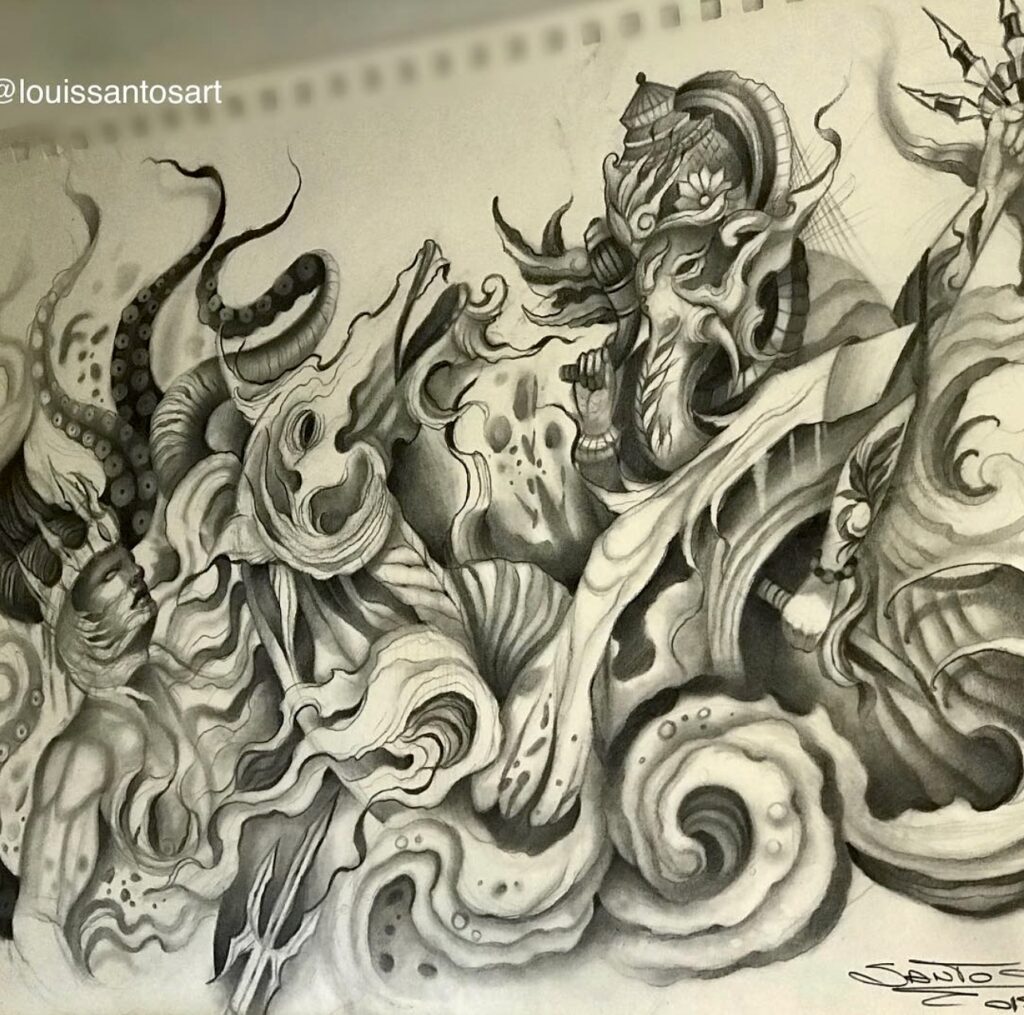


Poseidon / Ganesh Pencil Art

Genisha Tattoo Leeds

Mythology Tattoo Idea Leeds

In a world where mythology and fantasy intertwine, the ancient realms of Greek and Hindu mythology converge in a tale that transcends time and space. At the heart of this enchanting narrative are Poseidon, the Greek God of the Sea, and Ganesh, the elephant-headed Hindu deity of wisdom and obstacles. In a celestial rift that bridges the gap between the pantheons, Poseidon and Ganesh find themselves inexplicably drawn together. The cosmos weaves a tapestry of intrigue, setting the stage for a quest that will challenge the very fabric of reality. Poseidon, with his trident in hand, had grown weary of the endless tides and the monotonous rhythms of the ocean depths. He yearned for adventure and sought to explore the uncharted waters beyond the boundaries of his realm. His longing for discovery ignited a spark within him, a desire to chart the seas of otherworldly dimensions. Meanwhile, Ganesh, the wise and benevolent deity, was tasked with preserving cosmic balance. He had detected disturbances in the celestial order, anomalies that threatened the stability of both the Greek and Hindu pantheons. With his innate wisdom and curiosity, Ganesh embarked on a journey to investigate the source of these disruptions. Their paths collided on a mystical island where the boundaries between land and sea were blurred. Poseidon’s aquatic domain merged seamlessly with Ganesh’s lush and vibrant jungles. It was here that the two gods met, their initial surprise soon turning into mutual respect. Recognizing that their shared quest held the key to restoring cosmic balance, Poseidon and Ganesh forged an unlikely alliance. Poseidon’s mastery of the elements and Ganesh’s profound wisdom created a formidable partnership. Together, they set out to uncover the truth behind the disturbances in the pantheons and to confront the enigmatic force responsible. Their journey was a mesmerizing odyssey through surreal landscapes, where oceans merged with enchanted forests, and ancient temples rose from the depths. Along the way, they encountered mythical creatures, tested their mettle against formidable challenges, and unraveled the cryptic clues leading them to the heart of the cosmic imbalance. As Poseidon and Ganesh delved deeper into the mysteries of their shared adventure, they discovered that their collaboration transcended the boundaries of their respective mythologies. Their union symbolized the harmony between cultures, a testament to the universal quest for knowledge and balance. In the climax of their epic quest, Poseidon and Ganesh confronted the enigmatic force, a primordial being seeking to upset the cosmic order. Through their combined strength, wisdom, and determination, they thwarted the threat and restored balance to the realms of both Greek and Hindu mythology. Their tale became legend, whispered across the celestial realms as a testament to the power of unity and understanding. Poseidon returned to the depths of the sea, his heart filled with newfound purpose, and Ganesh resumed his role as the guardian of wisdom and obstacles. Their shared adventure remained a timeless testament to the enduring bonds of friendship that transcended not only the boundaries of mythology but the very fabric of existence itself.


Z Brush, Digital Sculpting, Medusa Tattoo Idea

Tattoo Artist Leeds

I’m now experimenting with Z Brush, its a digital form of sculpting. Its taking me a while to get used to it, however, i do enjoy it, i could see myself doing more of those, so keep an eye for more updates coming from this site. I was experimenting with this greek mythology medusa, so i did’nt want to spend a lot of time doing the snakes, but hopefully, you get the idea. Thanks for looking. Click link bellow to follow my Instagram page.

Poseidon Greek Mythology Tattoo

One more for the collection of Greek Mythology Tattoos. I’m really focused on Greek Mythology and Egyptian related tattoos at the moment, it’s a subject I put my heart to it, as I’m fascinated by Egyptians and Greek Gods, and how they lived their life. I can not be more grateful to have been working with something I’m interested in. Thank you so much

  • Book your tattoo